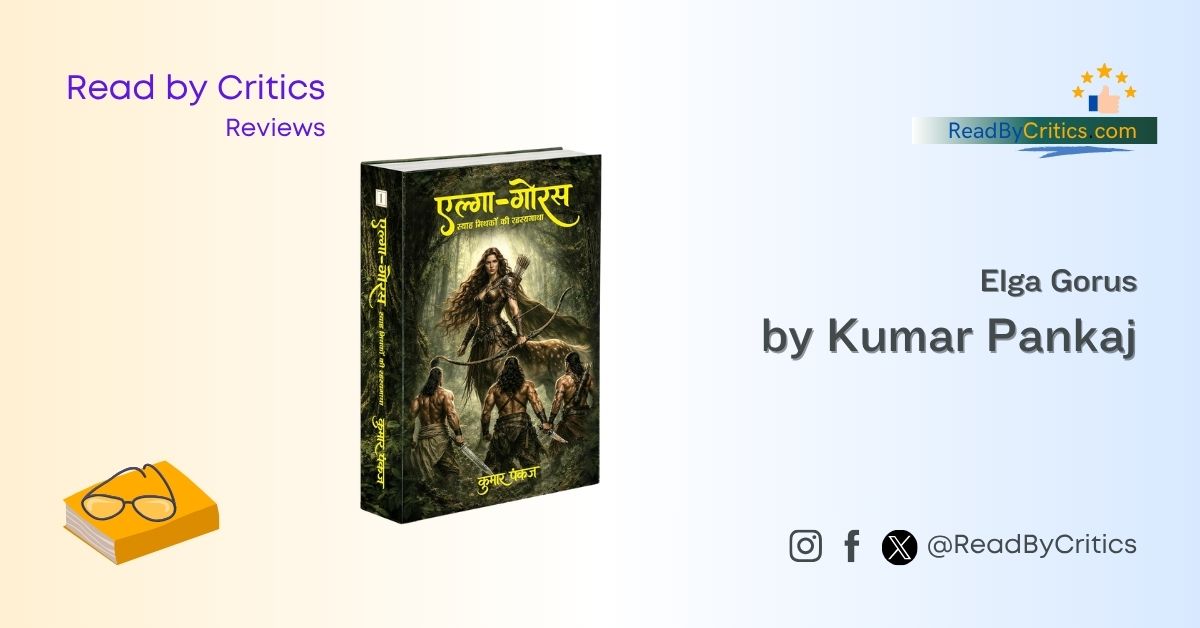
As someone who grew up reading both Chandrakanta and Harry Potter and the Philosopher’s Stone, I approached Kumar Pankaj’s Elga Gorus with a mixture of excitement and scepticism. On one hand, Chandrakanta had already shown me the immense possibilities of Hindi tilism, mystery, and adventure. On the other hand, the Harry Potter series has demonstrated how modern fantasy could create a complete universe capable of captivating readers across generations. The challenge before any contemporary Hindi fantasy writer, therefore, is enormous. Such a writer must not only satisfy readers familiar with the rich tradition of Hindi mystery literature but must also compete with the expectations shaped by internationally celebrated fantasy works. After completing both volumes of Elga Gorus, I can confidently say that Kumar Pankaj has achieved something remarkably ambitious. Rather than imitating either tradition, he has created a distinctive literary space where the spirit of Hindi tilism meets the expansive imagination of modern fantasy.
The first thing that struck me about Elga Gorus was its confidence. Many contemporary fantasy novels seem overly conscious of their influences. Readers can often identify traces of Tolkien, Rowling, Lewis, Martin, or other famous writers within them. Elga Gorus feels refreshingly different. From its opening pages, the novel establishes its own atmosphere. The mysterious sacred book engraved on thousands of wax tablets, the forgotten scripts, the hidden histories, the strange races, and the dark mythological undertones immediately signal that this is not an attempt to recreate a Western fantasy world in Hindi. Instead, Kumar Pankaj is building a mythology that belongs entirely to his own imagination. This originality is perhaps one of the novel’s greatest strengths. In an age when fantasy literature is often dominated by familiar formulas, Elga Gorus manages to feel genuinely new.
Comparisons with Chandrakanta are inevitable, and in some ways they are entirely justified. Like Devaki Nandan Khatri’s classic work, Elga Gorus thrives on mystery. Readers are constantly confronted with hidden meanings, secret locations, strange revelations, and unexplained phenomena. There is the same sense of intellectual curiosity that made Chandrakanta so addictive for generations of readers. Every answer seems to generate another question. Every discovery opens the door to another mystery. Yet Elga Gorus differs significantly in its scale and structure. While Chandrakanta relied heavily upon tilism, intrigue, and adventure, Kumar Pankaj expands the canvas considerably. His world includes not only hidden mechanisms and secret histories but entire races, mythological creatures, ancient civilisations, and complex systems of magical and symbolic knowledge. In that sense, Elga Gorus feels closer to the expansive world-building associated with modern fantasy literature while preserving the mystery-driven energy that made Hindi tilism so compelling.
When compared with Harry Potter, the differences become even more interesting. J. K. Rowling’s achievement lies largely in her ability to make magic feel familiar and accessible through an educational setting that readers immediately understand. Hogwarts functions as an entry point into a magical world. Kumar Pankaj adopts a very different strategy. He does not gradually ease readers into fantasy. Instead, he immerses them in it from the very beginning. The world of Elga Gorus is mysterious, ancient, and often unsettling. Readers are not invited into a school where magic is taught. They are thrown into a landscape where mystery itself is a living force. This creates a fundamentally different reading experience. While Harry Potter often evokes wonder and excitement, Elga Gorus frequently evokes wonder mixed with uncertainty, curiosity, and even awe. Its atmosphere is darker, more mythological, and often more enigmatic.
What impressed me most across both volumes was Kumar Pankaj’s ability to create a fantasy universe that feels culturally closer to Indian readers. This is where I believe the novel possesses a distinct advantage over many Western fantasy works. Readers may admire Hogwarts, Middle-earth, or Westeros, but these worlds ultimately emerge from cultural traditions different from our own. Elga Gorus feels rooted in a storytelling sensibility that Indian readers instinctively understand. The emphasis on hidden knowledge, sacred texts, ancient wisdom, mysterious ascetics, symbolic journeys, and mythological ambiguity resonates deeply with Indian narrative traditions. Even when the creatures and settings are entirely original, there is something familiar about the way mystery operates within the story. Readers feel less like tourists exploring a foreign land and more like participants rediscovering a forgotten part of their own imaginative heritage.
The characters deserve special appreciation because they prevent the novel from becoming merely an exercise in world-building. Fantasy literature often faces the risk of becoming so absorbed in mythology that human connections disappear. Kumar Pankaj avoids this problem by populating his world with memorable and emotionally engaging figures. The cast is extensive, particularly across two volumes, yet many characters remain distinct because of the emotional and psychological detail with which they are presented. Readers encounter warriors, wanderers, mystics, strange beings, and enigmatic figures whose motivations unfold gradually throughout the narrative. What makes these characters effective is that their emotional experiences remain relatable. Their fears, loyalties, ambitions, and uncertainties create connections that transcend the fantastical framework of the story.
The visual richness of the novel is another aspect that deserves recognition. Throughout both volumes, Kumar Pankaj demonstrates a remarkable ability to create vivid imagery. The mysterious caves, ancient settlements, dangerous landscapes, forgotten realms, and strange creatures are described with extraordinary clarity. Many scenes possess a cinematic quality that makes them easy to imagine. In fact, one of the pleasures of reading Elga Gorus lies in visualising its world. The novel rarely relies upon abstract descriptions. Instead, it consistently presents readers with tangible images that enhance immersion. This visual strength helps distinguish the work from many contemporary novels whose settings often feel generic or underdeveloped.
The second volume deserves particular praise because it builds successfully upon the foundation established by the first. Many fantasy series struggle with continuation. Either they repeat familiar ideas, or they become so complex that readers lose interest. Elga Gorus manages to avoid both problems. The second volume expands the mythology, deepens the mysteries, and raises the emotional stakes without sacrificing coherence. In many ways, it feels even more rewarding than the first volume because readers already possess a strong emotional investment in the characters and the world. The narrative momentum increases, and the sense of discovery remains intact. By the end, readers feel that they have travelled through a genuinely vast literary landscape.
One of the most important contributions of Elga Gorus may be its potential influence on younger readers. Contemporary Indian readers, especially younger ones, often turn toward English-language fantasy because they believe that such experiences are unavailable in Hindi. Kumar Pankaj challenges that assumption directly. He demonstrates that Hindi literature can support large-scale fantasy narratives, intricate world-building, memorable characters, and immersive storytelling. More importantly, he provides younger readers with a fantasy universe that feels culturally meaningful without sacrificing excitement or imagination. In a literary environment where reading habits are constantly competing with digital entertainment, books like Elga Gorus perform an important function. They remind readers that literature can still offer experiences as immersive and thrilling as any film, television series, or video game.
Of course, the novel’s ambition occasionally creates challenges. The large number of characters, locations, and mythological elements requires careful attention from readers. This is not a book that can be read casually while multitasking. It demands immersion. Some readers accustomed to simpler narratives may initially find the scale overwhelming. Yet these challenges arise largely from the richness of the world rather than from any deficiency in the writing. Readers who invest themselves in the story are likely to find the rewards substantial.
Ultimately, what makes Elga Gorus special is not merely its fantasy elements but its confidence in the power of imagination. Kumar Pankaj has taken a significant creative risk by attempting to build a large-scale fantasy universe within contemporary Hindi literature. More importantly, he has succeeded in making that universe feel alive, culturally resonant, and emotionally engaging. Readers familiar with both Chandrakanta and Harry Potter will find fascinating points of comparison, but they will also discover that Elga Gorus stands comfortably on its own. It inherits the mystery and intrigue of the Hindi tilism tradition while embracing the expansive possibilities of modern fantasy. For readers who enjoy mythology, mystery, adventure, elaborate world-building, and character-driven fantasy, I would strongly recommend both volumes. They represent one of the most ambitious and imaginative contributions to contemporary Hindi fantasy literature and offer a reading experience that is both deeply entertaining and culturally meaningful.
You can get a copy of this novel from Amazon India – click here to buy one now.
Review by Manish for ReadByCritics
Thanks for reading!
Elga Gorus by Kumar Pankaj: A Detailed Book Review
-
ReadByCritics Rating
Summary
If you liked watching Chandrakanta, or even better reading it, Elga Gorus is for you… a must-read mythical, fantasy and imaginative novel of a dense kind… you will be mesmerised by the storytelling and its visual appeal.