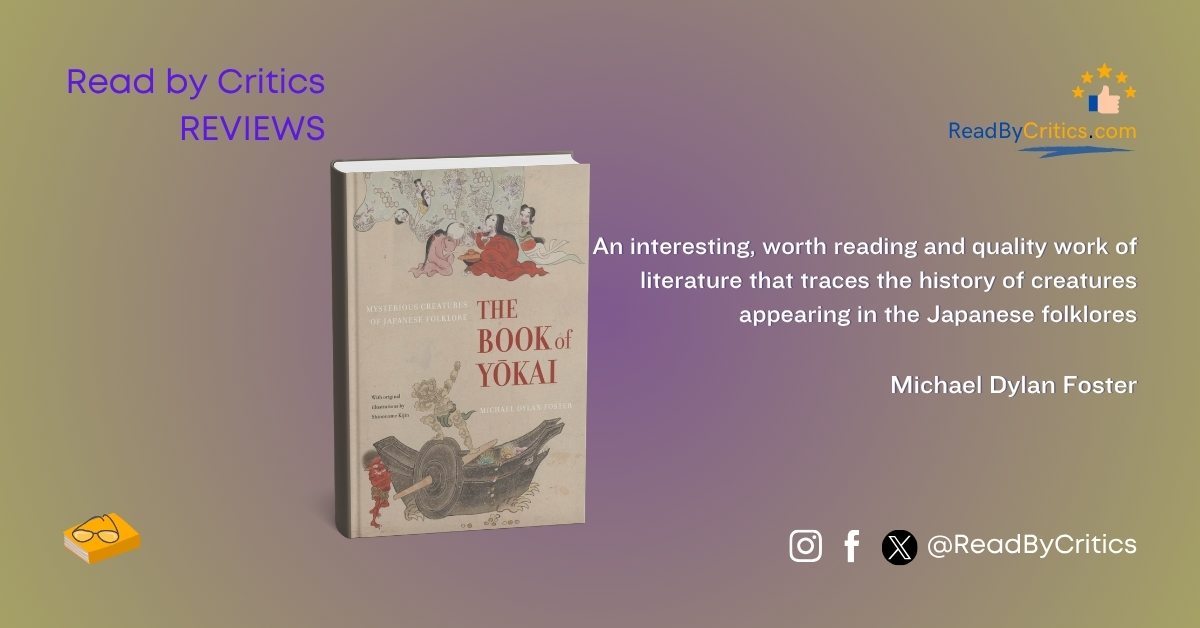
Some books explain a civilisation, while others take readers on a journey to inhabit its imagination. Michael Dylan Foster’s The Book of Yōkai: Mysterious Creatures of Japanese Folklore belongs decisively to the latter category. At first glance, the volume appears to be an encyclopaedic catalogue of Japan’s supernatural creatures, complete with illustrations and descriptions of mountain goblins, shape-shifting foxes, water spirits, animated household objects, and innumerable mysterious beings that have haunted Japanese folklore for centuries. Such an impression, however, would underestimate the intellectual ambition of Foster’s work. Far from producing a conventional field guide to monsters, he has written one of the most insightful cultural studies of Japanese folklore in recent decades. The book demonstrates that yōkai are not merely mythical creatures inhabiting an imaginary world but sophisticated cultural constructs through which generations of Japanese people have interpreted nature, society, morality, fear, memory, and the unknown. Combining the rigour of an academic scholar with the narrative ease of an accomplished storyteller, Foster transforms folklore into an engaging exploration of Japanese civilisation itself. The result is a work that deserves recognition not simply as a study of supernatural beings but as an indispensable contribution to Japanese cultural studies, folklore, literary criticism, and comparative mythology. The first edition, published in 2015 by the University of California Press, established itself as a leading study of the subject, and the expanded second edition broadens its historical scope and visual material while tracing the continuing influence of yōkai in contemporary popular culture.
One of the book’s greatest achievements lies in Foster’s refusal to define yōkai too narrowly. Readers expecting a dictionary of ghosts quickly discover that the Japanese supernatural universe resists rigid categorisation. Foster explains that yōkai encompass monsters, spirits, strange phenomena, transformed animals, animated objects, local legends, and unexplained occurrences whose meanings have shifted continuously across history. Instead of forcing these diverse beings into a fixed taxonomy, he encourages readers to appreciate their fluidity. This methodological choice is particularly significant because folklore itself thrives upon variation rather than certainty. Every region preserves its own versions of familiar creatures, every generation reinvents inherited legends, and every historical period discovers new meanings within old stories. Foster wisely recognises that attempting to produce definitive classifications would betray the very nature of folklore. Consequently, The Book of Yōkai becomes a study not merely of creatures but of the cultural processes through which societies imagine, preserve, reinterpret, and transmit the mysterious.
The historical depth of the book distinguishes it from the growing number of popular publications devoted to Japanese monsters. Foster refuses to isolate folklore from history. Instead, he traces the evolution of yōkai across more than a millennium of Japanese civilisation, revealing how changing religious beliefs, political structures, artistic traditions, technological developments, and social anxieties continually reshaped the supernatural imagination. Medieval picture scrolls, Buddhist cosmology, Shinto beliefs, Edo-period publishing, Meiji modernisation, twentieth-century manga, post-war animation, and contemporary digital media all become interconnected chapters within a single cultural narrative. Such breadth allows readers to understand that folklore is never static. Monsters evolve because societies evolve. New fears create new supernatural forms, while ancient legends acquire unexpected relevance in changing historical circumstances. Foster’s command over this vast chronological landscape is impressive, and his scholarship never overwhelms the reader despite the remarkable density of historical material.
Perhaps the most intellectually rewarding aspect of the book is its insistence that yōkai reveal more about human beings than about imaginary creatures. Every supernatural entity embodies a particular cultural anxiety, ethical dilemma, environmental experience, or psychological uncertainty. The mischievous kappa emerging from rivers reflects both humanity’s dependence upon and fear of water. Shape-shifting foxes challenge assumptions concerning identity and deception. Animated household objects remind readers of traditional attitudes towards craftsmanship, material culture, and the moral significance of everyday possessions. Mountain spirits emerge from communities negotiating dangerous landscapes where survival depended upon respecting nature’s unpredictability. Foster repeatedly demonstrates that the supernatural functions as a language through which societies explain experiences that resist ordinary rationality. By shifting attention from monsters themselves to the cultural imagination responsible for creating them, he elevates folklore from entertaining superstition to serious intellectual inquiry.
Equally admirable is Foster’s interdisciplinary methodology. Although trained as a scholar of Japanese folklore, he moves comfortably between anthropology, literary studies, religious history, visual culture, sociology, media studies, and cultural theory. This interdisciplinary perspective enriches every chapter. Rather than discussing yōkai exclusively through literary texts, he analyses paintings, woodblock prints, temple traditions, theatrical performances, oral storytelling, manga, anime, cinema, museums, tourism, and commercial merchandising. Such an approach reflects an important truth about Japanese folklore: it has never belonged exclusively to literature. Instead, it circulates continuously across multiple artistic and cultural forms. Foster captures this remarkable vitality with exceptional clarity, revealing how ancient legends continue to inhabit contemporary Japan without losing their historical resonance.
The organisation of the book further enhances its scholarly value. The opening chapters establish the conceptual framework necessary for understanding yōkai, introducing readers to the historical development of the term and examining the shifting meanings attached to supernatural beings across different periods. These discussions are followed by what is perhaps the volume’s most enjoyable section: the Yōkai Codex. Here Foster presents detailed entries on numerous individual creatures, describing their origins, characteristics, geographical associations, literary appearances, and cultural significance. Importantly, these entries avoid the superficiality often associated with encyclopaedic reference works. Each creature becomes the starting point for broader reflections upon Japanese history and folklore. The accompanying illustrations by Shinonome Kijin greatly enrich the reading experience, capturing both the grotesque humour and aesthetic elegance characteristic of traditional yōkai art. The expanded second edition further strengthens this visual dimension by adding a substantial gallery that traces changing artistic representations of yōkai across centuries.
Foster’s prose deserves particular praise. Academic studies of folklore frequently suffer from excessive technicality, sacrificing readability for scholarly precision. The Book of Yōkai demonstrates that intellectual rigour and literary elegance need not be mutually exclusive. Foster writes with clarity, wit, and quiet enthusiasm, inviting readers into complex discussions without oversimplifying them. His occasional humour never undermines scholarly seriousness; rather, it reflects the playful spirit inherent in many yōkai traditions themselves. Consequently, the book remains accessible to general readers while offering sufficient analytical depth to satisfy specialists in folklore, Japanese studies, literary criticism, and comparative mythology. Achieving this balance is no small accomplishment.
Nevertheless, no serious work escapes critical scrutiny. Readers seeking exhaustive treatment of every major yōkai tradition may occasionally find Foster’s discussions necessarily selective. Given the extraordinary diversity of Japanese folklore, comprehensive coverage would require several volumes rather than one. Likewise, some literary scholars may wish for more sustained engagement with classical texts such as Konjaku Monogatari, Ugetsu Monogatari, or Lafcadio Hearn’s Kwaidan, whose influence upon modern understandings of Japanese supernatural literature remains profound. Foster certainly acknowledges these traditions, but his principal concern lies with cultural processes rather than extended literary analysis. This emphasis reflects the book’s anthropological orientation rather than any scholarly omission. Similarly, theoretical readers may occasionally desire deeper engagement with broader debates concerning myth, structuralism, or narrative theory. Yet these minor reservations scarcely diminish the book’s considerable achievements.
One of the volume’s most significant contributions lies in dismantling persistent misconceptions surrounding Japanese supernatural culture. Popular media has encouraged many international audiences to equate Japanese folklore exclusively with horror. Foster convincingly demonstrates that such a perception is historically inaccurate. Many yōkai inspire amusement rather than terror; others function as moral instructors, protectors, tricksters, symbols of environmental awareness, or embodiments of communal identity. Fear constitutes only one emotional register among many. This nuanced interpretation allows readers to appreciate the extraordinary richness of Japanese folklore beyond the narrow confines of horror fiction.
The contemporary relevance of Foster’s work further enhances its importance. At a time when anime, manga, video games, and Japanese cinema enjoy unprecedented international popularity, countless readers encounter yōkai without understanding their historical origins. Foster bridges this gap with remarkable effectiveness. He reveals how contemporary cultural production continually reinterprets traditional folklore, ensuring that centuries-old supernatural beings remain culturally vibrant rather than museum relics. In doing so, he reminds readers that folklore survives not by resisting change but by adapting creatively to new historical environments.
Ultimately, The Book of Yōkai succeeds because it refuses to treat mythology as escapism. Instead, Foster demonstrates that supernatural narratives illuminate the deepest structures of cultural memory. They reveal how communities negotiate uncertainty, domesticate fear, interpret natural phenomena, transmit ethical values, and preserve collective identity across generations. The creatures inhabiting these pages may never have existed in physical reality, yet they remain profoundly real within the cultural imagination that produced them. To understand yōkai is therefore to understand something essential about Japan itself.
Few contemporary studies combine meticulous scholarship, historical breadth, literary sensitivity, anthropological insight, and engaging prose with such confidence. Michael Dylan Foster has produced not simply the definitive introduction to Japanese supernatural folklore but one of the finest examples of modern cultural criticism. Whether approached as folklore, literary history, mythology, anthropology, or simply as an invitation into one of the world’s richest imaginative traditions, The Book of Yōkai rewards careful reading on every level. It reminds us that monsters are never merely creatures lurking in darkness; they are enduring reflections of the societies that dream them into existence.
Rishi M for ReadByCritics