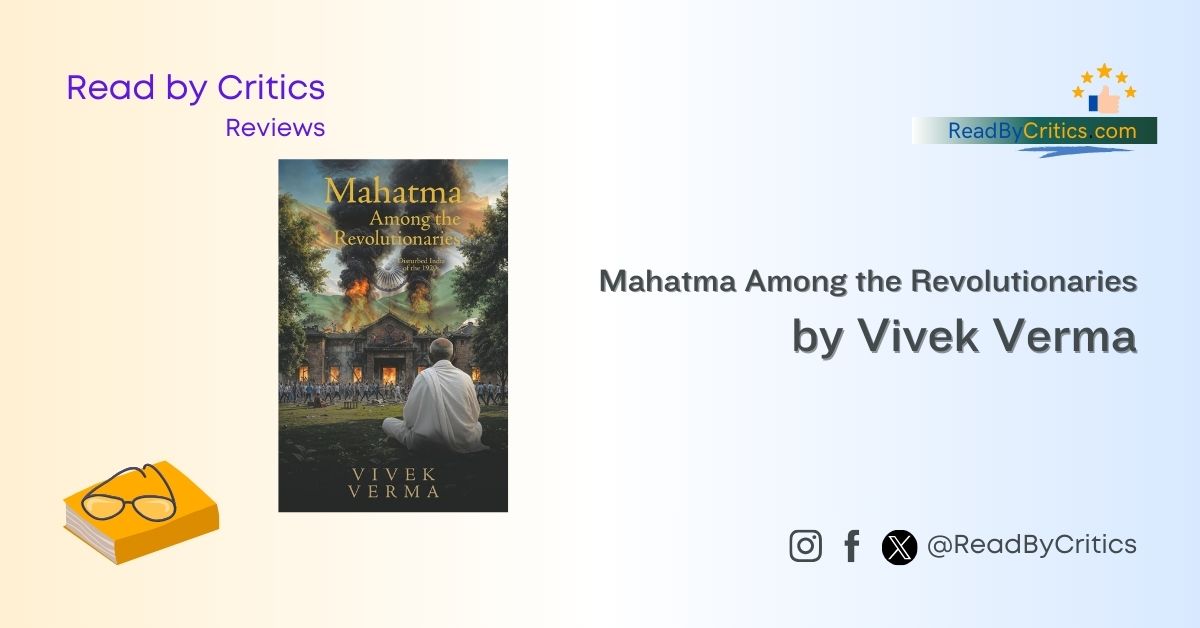
Mahatma Among the Revolutionaries reminds us, with quiet insistence, that history is rarely the solid structure we imagine it to be. More often, it is a mirage shaped by repetition, pedagogy, political convenience, and selective memory. What we inherit as “history” is frequently a settled perception of events rather than the events themselves. Over time, this perception hardens into certainty, which in turn discourages questioning. Vivek Verma’s book enters precisely at this fragile fault line between memory and meaning, offering readers an opportunity to revisit the Indian freedom struggle not as a closed chapter but as a living, contested narrative that still resists simplification.
One of the book’s most important contributions is its insistence that the Indian national movement cannot be understood through a single moral lens. Verma begins far earlier than the 1920s, tracing the origins of colonial dominance with a candour that unsettles familiar assumptions. When George Curzon is quoted as believing that British India was the “true fulcrum of Asian dominion,” and admitting that the loss of India would reduce Britain to “a third-rate power,” the statement functions as a corrective to generations of euphemistic colonial histories. This was not governance motivated by civilisational duty or reluctant administration. It was an exercise in preserving global power. The mirage of a benevolent empire dissolves when the empire speaks honestly about itself.
This is precisely why history demands periodic reinterpretation. As societies change, so do the questions they ask of the past. What once appeared as orderly progress may later reveal itself as suppression. What was taught as moderation may appear, under new scrutiny, as delay imposed through force. Vivek Verma does not rewrite history by inventing new facts. Instead, he rearranges emphasis, restores silenced voices, and places well-known figures back into the contentious environments they inhabited. In doing so, he exposes how earlier narratives flattened complexity in the service of coherence.
The revolutionary movement, for instance, is often remembered either as heroic martyrdom or reckless violence, depending on ideological inclination. Verma resists both extremes. He draws attention to the revolutionary mindset by allowing its own words to speak for themselves. When the revolutionaries insisted that their goal was not to seize power but to destroy British rule and “probably recreate something else,” the statement reframes their actions as a political strategy rather than a nihilistic impulse. This distinction matters. It forces the reader to recognise that armed resistance was not merely an emotional reaction but a reasoned response to systematic exclusion from constitutional processes.
The book repeatedly demonstrates how colonial governance manufactured radicalism. The Jallianwala Bagh massacre is not treated as an isolated moral failure but as the logical consequence of a state that believed terror to be pedagogical. General Dyer’s admission that he wanted to “make a wide impression” and reduce morale across Punjab exposes a philosophy of rule based on fear rather than legitimacy. In contrast, Winston Churchill’s assertion that British rule had never relied on physical force alone appears hollow when placed alongside such testimony. Verma does not editorialise. He juxtaposes statements and allows their contradictions to indict the system that produced them.
If history is a mirage, Gandhi is perhaps its most carefully curated image. Vivek Verma does not dismantle Gandhi, but he does strip away the layers of reverence that prevent critical engagement. Gandhi’s own words reveal a far more complex political thinker than popular memory allows. When Gandhi declared that “there is no salvation for India unless you strip yourselves of this jewellery and hold it in trust for your countrymen,” he was not merely advocating personal austerity. He was challenging an Indian elite that had learned to coexist comfortably with colonial exploitation. His insistence that “our salvation can only come through the farmer” exposes a radical economic vision often overshadowed by the symbolism of nonviolence.
At the same time, Verma refuses to present Gandhi as morally isolated from the revolutionary ferment around him. Gandhi’s acknowledgement that he would be prepared to declare the English must go if India’s salvation required it complicates the caricature of passive resistance. Yet his criticism of the bomb thrower as one who operates in secrecy and pays the price of “misdirected zeal” reveals an ethical boundary he refused to cross. The book does not attempt to reconcile these positions. Instead, it shows how Gandhi and the revolutionaries inhabited the same historical moment while drawing radically different conclusions from it.
This is where the necessity of fresh historical interpretation becomes most evident. Traditional narratives often arrange the freedom struggle as a linear progression from extremism to maturity, from violence to nonviolence, from chaos to discipline. Verma dismantles this chronology. He shows that armed and nonviolent resistance coexisted, overlapped, and influenced one another throughout the 1920s. The British response, too, was not uniform. Political revolutionaries were handled with cautious surveillance, while those labelled anarchists faced repression. The colonial state itself recognised distinctions that later histories collapsed into moral binaries.
Gandhi’s mass movements are re-examined through this lens. His statement in Young India, “On bended knee, I asked for bread and received a stone instead,” is not treated as rhetorical flourish but as political diagnosis. It marks the exhaustion of dialogue under unequal conditions. Verma shows how the Salt Satyagraha was not merely symbolic protest but an attempt to demonstrate that empire depended on Indian cooperation at the most basic levels of daily life. When Gandhi urged women to guard illicit salt “as she would hold to her fond child,” he transformed resistance into an act of care and moral guardianship. This was not softness. It was an emotional mobilisation on a national scale.
Parallel to this moral mobilisation ran a current of anger that could not be absorbed into Gandhian discipline. The protests against the Simon Commission and the death of Lala Lajpat Rai intensified revolutionary resolve. Statements defending violent retaliation as necessity must be read, Verma suggests, not as celebrations of bloodshed but as indictments of a system that refused accountability. The phrase “It needs explosions to make the deaf hear” is thus contextualised as a critique of imperial deafness rather than a glorification of violence. Such reframing is precisely what fresh historical interpretation allows. It does not excuse violence, but it explains why violence became intelligible to those denied voice.
The declaration of Purna Swaraj under Jawaharlal Nehru represents another moment where history is often simplified. Verma situates it as an attempt to align mass politics with revolutionary impatience. Yet this alignment remained incomplete. The rupture becomes unmistakable in Subhas Chandra Bose’s rejection of the Gandhi-Irwin Pact. When Bose declared that “between us and the British government lies an ocean of blood and a mountain of corpses,” he articulated a moral reality that compromise could not erase. Vivek Verma recuses himself from passing sweeping judgments. He does not frame Bose as reckless or Gandhi as a betrayer. He presents both as responses to the same historical wound, interpreted through different ethical frameworks.
This approach makes the book particularly valuable for readers who are weary of settled narratives. Students of history, political theory, and postcolonial studies will find in this work a model for revisiting the past without anachronism. The book is equally relevant to general readers who sense that the story they were taught feels incomplete but lack the material to articulate why. Verma supplies that material through careful citation, restrained prose, and an evident respect for complexity.
The prose itself deserves mention. Verma writes without melodrama, trusting the weight of historical voices. He allows imperial officials, revolutionaries, and national leaders to speak in their own words, often in uncomfortable proximity. This method restores tension to a history too often resolved in advance. The reader is not guided toward moral comfort but invited into moral difficulty. That invitation is rare in popular historical writing.
I recommend this book because it does not tell readers what to think. It asks them to think again. It reminds us that history, when left uninterrogated, becomes a mirage reflecting our present assumptions rather than past realities. Vivek Verma offers not revisionism but renewal. He shows why history must be revisited periodically, not to change facts, but to change questions. In doing so, Mahatma Among the Revolutionaries restores depth, conflict, and seriousness to the story of India’s freedom struggle. It is a book for readers who value understanding over reassurance, and who recognise that the past, like the present, resists easy resolution.
Get a copy from Amazon India or Worldwide – click here to get one now!
Review by Rahul for ReadByCritics
Thanks for reading!
Mahatma Among the Revolutionaries: Disturbed India of the 1920s
-
ReadByCritics Rating
Summary
You cannot hide from the layers of truth… as they reveal themselves in fresh interpretations… from time to time. This one is highly recommended!